AI Hallucinations in Legal Practice: Risks and Mitigation Strategies

AI hallucinations are a significant risk in legal practice because legal work depends on accurate authorities, jurisdictional relevance, procedural correctness, and verifiable sources. Hallucinations can appear as fabricated citations, misstated case holdings, incorrect procedural guidance, blended legal doctrines, or unsupported reasoning.
The safest approach is not to eliminate human involvement but to build AI into a controlled verification workflow. Legal teams should verify citations against primary sources, apply stricter review to high-risk work, document verification steps, train users to recognize hallucination patterns, and use systems grounded in authoritative legal sources.
What “hallucination” means in legal work

AI hallucinations in legal practice can include fabricated citations, incorrect case holdings, unsupported legal claims, and false procedural guidance. These errors can impact court filings, client advice, and legal strategies, creating risks such as sanctions, malpractice, and loss of professional credibility.
Common examples include fabricated legal citations, incorrect deadlines, blended legal doctrines, and unsupported reasoning. Since AI-generated content can sound confident and professional, legal teams should treat it as provisional and verify important information against authoritative primary sources before relying on it.
A clear human verification workflow can help reduce AI hallucination risks while maintaining accuracy and accountability.
Verify every citation against primary sources

Every AI-assisted legal research process should begin with authoritative source verification. Every case, statute, regulation, rule, and legal quote should be checked against an official source or trusted legal database before it is used. A simple rule can help prevent citation errors: if an authority cannot be independently located and verified, it should not be cited. This is especially important because general-purpose AI chatbots can produce hallucinated citations, while legal AI tools grounded in verified legal databases and citation systems can reduce this risk, although they cannot eliminate it entirely.
The level of legal AI review should also depend on the risk involved. Lower-risk tasks, such as brainstorming legal issues or creating preliminary research lists, may require lighter review, while high-risk work such as appellate briefs, dispositive motions, and client advice requires much stricter verification. Law firms can strengthen AI legal research quality control by using formal risk ratings and increasing the level of human review as the potential consequences increase.
To make AI governance in law firms more reliable, firms should establish a standardized review process that includes independent citation checking, reviewing the original source text instead of relying solely on AI-generated summaries, escalating complex legal issues to experienced attorneys, and obtaining attorney sign-off before AI-assisted work is filed or shared externally. Maintaining a simple AI audit trail showing what was checked, where it was verified, and who reviewed it can further improve accountability and make legal quality control auditable—particularly when multiple people contribute to the same draft.
Train lawyers and staff on failure patterns
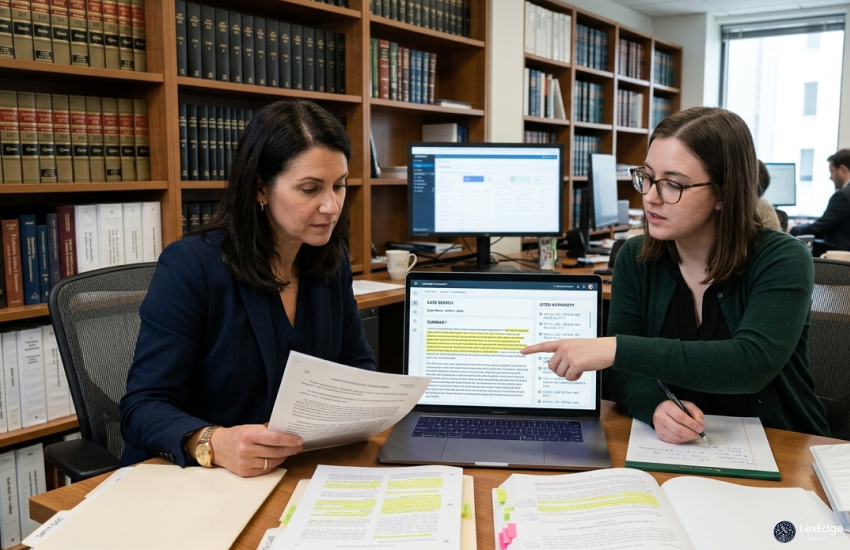
Effective AI risk management in law firms starts with training users to recognize how hallucinations appear in practice. Legal professionals should be trained to identify fabricated citations, incorrect quotations, and blended legal doctrines, while also learning prompt discipline, document review practices, and situations where AI should not be used at all. However, hallucination risk is only one part of the broader legal AI risk landscape. Firms must also protect confidential client information by using appropriate systems, with safeguards such as data anonymization, access controls, encryption, and thorough AI vendor reviews.
One of the biggest challenges with AI hallucinations in legal work is that they cannot currently be eliminated completely. Even professional-grade legal AI tools can generate incorrect answers, and convincing outputs may create false confidence among users who are not trained to verify sources. Firms can also face inconsistent risk exposure when attorneys use different AI systems—for example, one lawyer using a verified legal research platform while another relies on a general-purpose chatbot. Increasing pressure to draft faster can make this problem worse, as teams may be tempted to skip the AI verification process that protects accuracy. This creates an important balance between AI convenience and legal accuracy, making strong governance essential.
A major development in legal AI technology is the move from generic AI generation toward retrieval-augmented generation (RAG) and other systems that ground responses in verified legal materials. These approaches can reduce hallucination risk compared with unconstrained chat interfaces, but human review remains essential. At the workflow level, firms are also adopting stronger AI governance guardrails, including automated citation checks, audit trails, confidence indicators, and clear policies defining when AI can be used. As courts and professional bodies establish stronger expectations around AI transparency, verification, and accountability, the most realistic future is supervised legal AI—technology that helps attorneys work faster while preserving professional judgment. The firms most likely to benefit will be those that combine capable AI tools with disciplined human oversight and verification processes, rather than relying on technology alone to guarantee accuracy.
Conclusion
AI hallucinations in legal practice are more than a technical limitation—they can create reliability, ethical, reputational, and liability risks. Legal teams should treat AI-generated legal content as provisional until it has been independently verified. A strong approach combines authoritative sources, risk-based review, human oversight, user training, and workflow-level governance.